Machine learning as an on-box inspector
xorappsec uses ML on the box. It does not call a remote AI API. Every request is decoded, turned into features, and scored inside the xorappsec process. This page is the illustrated version of docs/architecture and docs/ml.
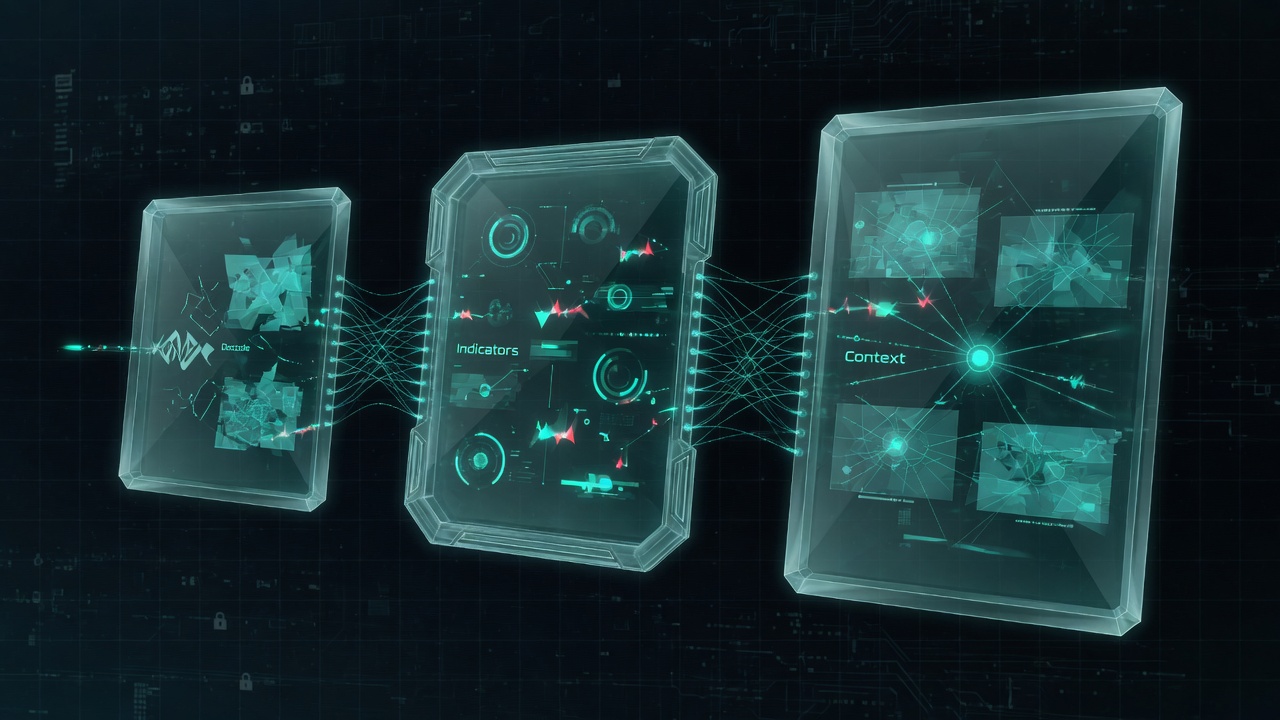
The four tasks in one binary
Phase 1 — decode
File: crates/xorsec-inspect/src/decode.rs. URL, HTML entities, hex, Base64, JWT claims, JSON/XML flatten, multipart, and ${…} lookup expansion (including ${::-j}). XML external entities are never fetched. If a payload is still opaque after this step, later phases cannot see it.
Phase 2 — indicators
File: indicators.rs plus ngram.rs. Families (SQLi, XSS, RCE, JNDI, Spring, …) are scores, not drops. Dual NORM+SIG trigrams boost a family when structural patterns survive letter substitution. Origin/Referer/Host/Cookie are skipped so a browser Origin is not treated as SSRF.
Phase 3 — context
File: ml.rs. Two models plus fusion:
- Supervised — 32-d logistic. Feature 31 is always
1.0(bias). Public basic weights ship in the binary;--supervised-modelloads a replacement. - Unsupervised — per-asset URL baselines (templated paths so
/users/42shares a model with/users/99) plus an Isolation Forest fitted on benign traffic only. - Reputation — EWMA per source identity.
score = (0.72·supervised + 0.14·unsupervised + 0.08·(1-reputation) + 0.06·indicator)
        × false_detection × crowd
if indicator ≥ 0.93: score = max(score, 0.93)   # JNDI / Spring class
if supervised ≥ 0.90: score = max(score, 0.78)
Those floors are why a Kindergarten asset still blocks decoded Log4Shell.
Learning levels
| Level | Typical gate | Recommendation |
|---|---|---|
| Kindergarten → High School | volume + time | Keep learning |
| Bachelor | ~5k+ requests | Review tuning suggestions |
| Graduate | mature, no trusted sources yet | Prevent critical |
| Master / PhD | trusted sources + tuning | Prevent high and above |
Trusted sources are not an allow-list. They accelerate the benign baseline after minNumOfSources distinct identities agree.
What stays local
Request bodies and keys never leave the process except what you enable in a log trigger. Training of the supervised vector happens in the private xorappsec-ml lab and is loaded as a JSON artifact. Online unsupervised state is data/unsupervised_model.json on the box.